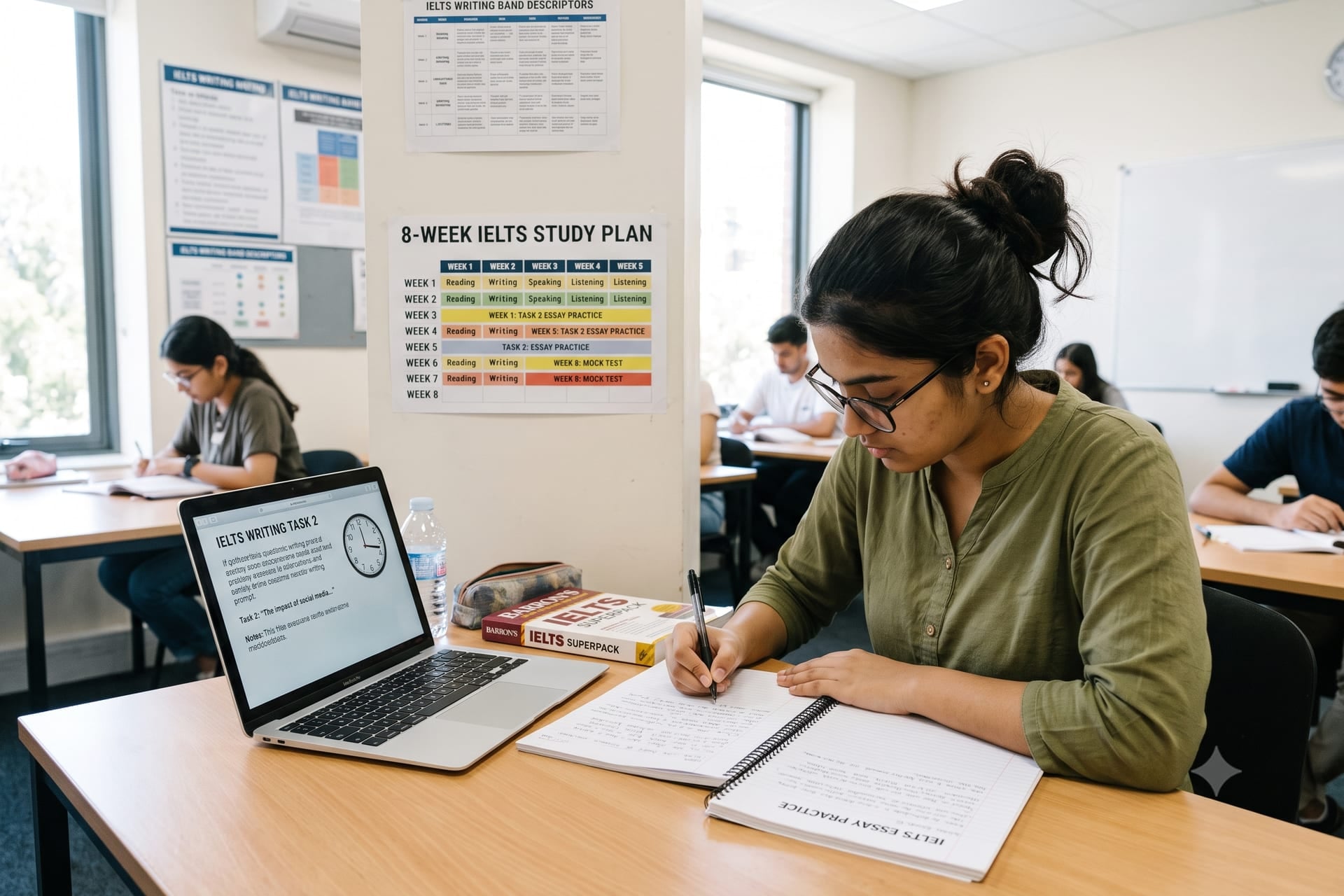

Quick Answer to Best IELTS Coaching Institute in Rajkot
The best IELTS coaching institute in Rajkot runs a full diagnostic before quoting you a course length, keeps batches small enough for individual writing feedback, and schedules timed mock tests. Group coaching in Rajkot typically costs INR 9,000-20,000 and most students need six to eight weeks. Because Rajkot has fewer institutes than Ahmedabad, visiting two or three and comparing batch size and marked-essay counts is realistic and worth doing. Global Colliance runs diagnostic-led IELTS and PTE coaching at its Rajkot centre, alongside the admissions and visa work that follows.
Rajkot's IELTS market is smaller than Ahmedabad's but no less varied in quality, and the smaller field can make choosing harder rather than easier: with fewer options, students often settle for whichever institute is nearest. This guide sets out what genuinely distinguishes the best IELTS coaching institute in Rajkot, what you should expect to pay, and how to assess a centre properly in a single visit.
The Real Difference Between Rajkot Institutes
The differences that matter are rarely the ones advertised. Every centre claims experienced faculty and small batches, so those claims carry no information. What varies genuinely is how much individual assessment you receive and whether the teaching is built around the exam or around general English.
IELTS rewards specific, learnable techniques. Reading is a search task rather than a comprehension exercise. Task 2 essays are marked against four published criteria that can be targeted deliberately. The Speaking test follows a fixed three-part structure that can be rehearsed. Institutes that teach these directly move bands faster than those teaching English broadly and hoping the score follows.
The second real difference is feedback volume. Writing improves in proportion to how many essays you write and have marked properly, and Speaking improves in proportion to how many minutes you spend talking under timed pressure with someone correcting you. Both are expensive to deliver, so both are where weaker institutes economise.
The third is whether the institute knows what your score is for. A student needing 6.0 for a Canadian college and one needing 7.0 with no band below 6.5 for a UK master's are on different paths, and an institute that never asks about your destination is running one plan for everybody.
Because Rajkot has fewer centres than the larger Gujarat cities, it is realistic to visit two or three before deciding. That comparison is genuinely worth the time, since differences in batch size and feedback quality become obvious only when you have something to measure against.
Batch Formats Available in Rajkot
Most Rajkot institutes offer weekday batches in morning and evening slots, along with weekend options for students who are working or studying full time. Morning batches are usually the smallest and, where your schedule permits, generally the better choice.
Evening batches tend to attract working candidates and are often the largest, which matters because batch size directly determines how much individual speaking and writing attention you receive. Ask for the number in the specific batch you would join rather than an average across the centre.
Weekend batches run the same syllabus across ten to twelve weeks. The extra time helps students who need language ability to build rather than technique to sharpen, but the gap between sessions requires disciplined practice in between or retention suffers.
Fast-track options of three to four weeks exist and suit a narrow case: a candidate already close to target who needs exam familiarity and timing work. For a student starting at Band 5.0, compressing preparation rarely produces the intended result.
Online batches have become a practical option for students in and around Rajkot who would otherwise commute, and they work well provided live speaking practice and individually marked writing are genuinely retained rather than replaced by recordings.
What You Should Expect to Pay in Rajkot
Group coaching in Rajkot typically ranges from around INR 9,000 to INR 20,000 depending on duration, batch size and how much individual feedback is included. One-to-one coaching generally starts near INR 25,000. These reflect prevailing market ranges rather than fixed prices.
Ask for the inclusion list in writing before paying. Study materials, full-length mock tests, individual writing evaluation and speaking sessions are the components most often charged separately, and a lower advertised fee can end up costing more once these are added.
Weigh the coaching fee against the test fee of roughly INR 17,000 to INR 18,000 per attempt. Because one retake costs more than most coaching courses in Rajkot, economising on preparation is usually a false saving.
Fees well below the local range generally indicate large batches with no individual feedback. That model is workable for Reading and Listening and consistently weak on Writing and Speaking, which are the modules that most often hold Indian candidates below their target.
Ask whether you can repeat the course if you do not reach your target band, and get the answer before enrolling rather than after a disappointing result.
Building a Realistic Band Target
The most common planning error is choosing a target band before checking what the destination actually requires, and the second most common is assuming a big improvement is achievable in a short time.
As a rough guide, moving half a band typically takes four to six weeks of consistent work, and a full band usually takes eight to twelve. Those ranges vary with starting level and study hours, but they are a more honest basis for planning than the timelines often quoted in advertising.
Your target should come from your universities, not from a general sense that higher is better. Many Canadian colleges accept 6.0 to 6.5 overall, while UK and Australian postgraduate programmes frequently require 6.5 to 7.0 with minimum scores in each individual band. That per-band minimum is what catches students out, since a strong overall score can still fail on one weak module.
It is also worth knowing that the One Skill Retake option now allows candidates to resit a single module rather than the whole test in many cases, which changes the calculation when one band falls just short of the requirement.
Our guide to IELTS requirements by country sets out what the major destinations genuinely ask for, and is worth reading before you fix a target.
How to Judge an Institute in One Visit
Attend a demo class rather than deciding from a phone call. An hour in the room shows you batch size, teaching pace and whether the trainer actively corrects students or delivers a lecture.
Ask to see a marked student essay with details removed. Feedback that references the band descriptors specifically indicates genuine evaluation; a bare score with a general remark indicates the opposite.
Ask directly how many students are in the batch you would join and how many minutes of individual speaking practice the course includes in total. Precise answers suggest a centre that tracks these things; vague ones suggest it does not.
Ask what the trainer's own IELTS band is. Trainers who have sat the exam understand its timing pressure from experience rather than from materials.
Finally, notice whether the institute is willing to tell you something you would rather not hear, such as that your target is unrealistic in your available weeks. That candour is a better indicator of quality than any amount of encouragement.
Why Students in Rajkot Choose Global Colliance
Global Colliance has trained more than 15,000 students across its test preparation programmes and has guided students abroad for almost 20 years. Our Rajkot centre runs IELTS alongside the admissions and visa work that follows it, so the band you prepare for is the one your intended universities actually require.
Every student starts with a diagnostic assessment rather than being placed straight into a syllabus. If you want a broader view of the local options, our guide on how to choose IELTS coaching in Rajkot covers the selection process, and our comparison of coaching versus self-study in Rajkot is useful if you are still deciding whether you need a course at all.
Because we guide students across every major destination rather than promoting one, the recommendation follows your profile. If you are weighing tests, our PTE comparison for Vadodara and Rajkot covers that choice, and our eight-week Band 7 plan shows how a full preparation cycle sequences.
For students who want the exam and the application handled by one team, our Rajkot student visa consultant page explains how the stages connect. A free assessment test is the sensible first move, since it establishes your current band before any plan is made.
Students who want the whole picture before committing can begin with our study abroad consultants in Rajkot, who handle course selection, documentation and visa filing together.
FAQs About IELTS Coaching in Rajkot
How long does IELTS coaching take in Rajkot?
Six to eight weeks suits most students. Candidates close to their target may need only three to four weeks, while moving more than a full band generally requires ten to twelve weeks of consistent preparation.
What is the typical IELTS coaching fee in Rajkot?
Group batches usually range from around INR 9,000 to INR 20,000 depending on duration and included feedback, with one-to-one coaching starting near INR 25,000. The IELTS test fee is separate.
How much can I realistically improve my band?
Half a band typically takes four to six weeks of consistent work and a full band eight to twelve, depending on your starting level and study hours. Improvements beyond that in a short window are uncommon.
Do I need a minimum score in each band?
Often yes. Many UK and Australian postgraduate programmes require a minimum in every individual module alongside the overall score, which means a single weak section can fall short even with a good overall band.
Is coaching necessary or can I self-study?
Reading and Listening respond well to self-study with good materials. Writing and Speaking are much harder alone, since both depend on qualified assessment against the official band descriptors rather than self-review.
Free download
IELTS Exam Guide for Indian Students
What IELTS tests, how it is scored, test dates and result times, and paper versus computer-delivered IELTS, in one free guide from Global Colliance. Enter your details and verify your email to open it.