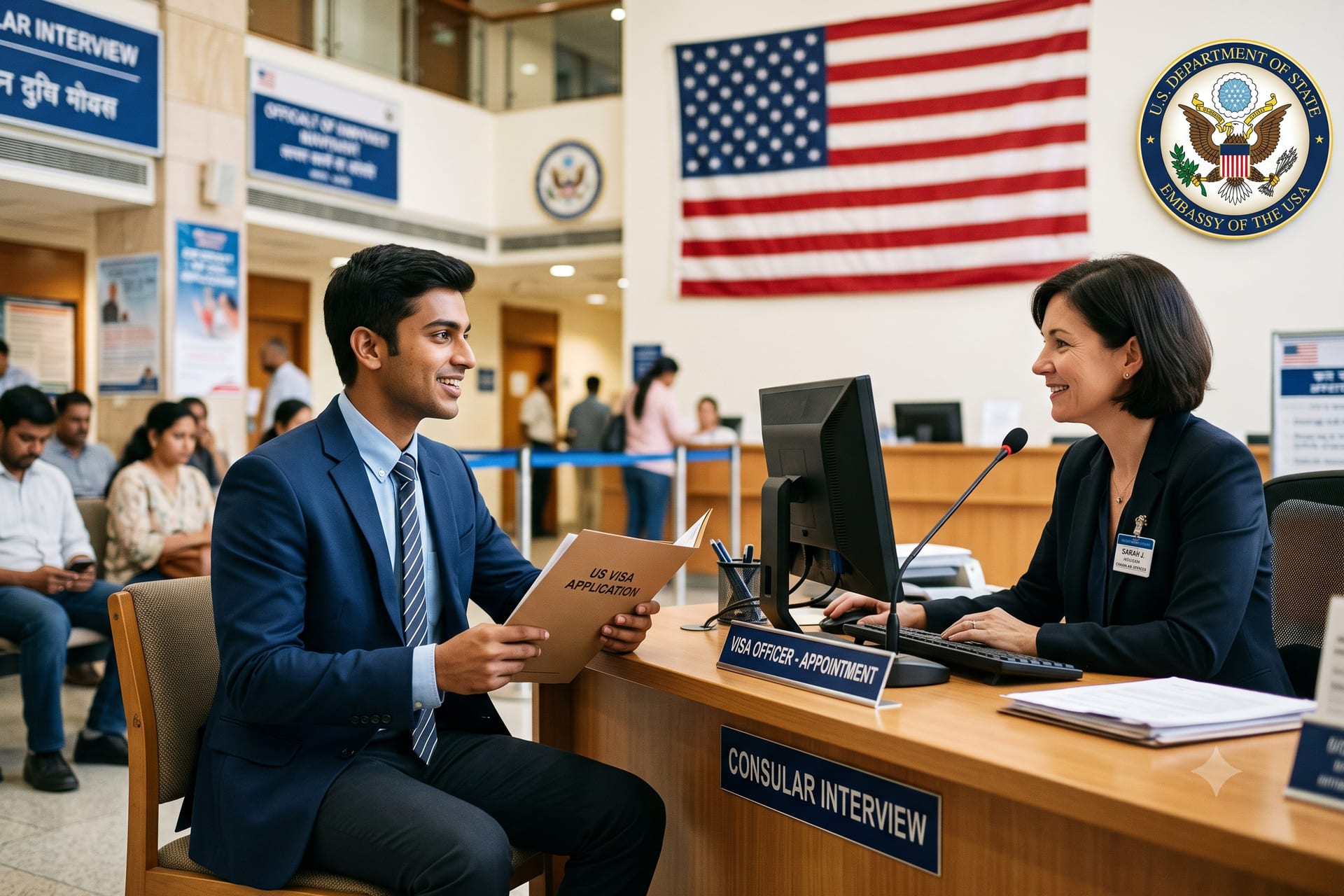

Quick Answer to Top 15 US F-1 Visa Interview Questions (with Answers)
F1 interviews are short and focus on three things: why this university and course, how you will pay for it, and what you intend to do afterwards. Answers should be specific, consistent with your I-20 and financial documents, and delivered concisely. Rehearsing the common questions matters less than being able to explain your own study plan clearly and without contradiction. Global Colliance prepares the financial documentation and interview practice these applications turn on.
The visa interview is the final and most decisive step in your American study journey. Knowing the most common US F-1 visa interview questions in advance, and understanding what the officer is really assessing, transforms nervousness into confidence. Having prepared many students for successful interviews, we have compiled the top 15 questions with sample answers and the reasoning behind each one.
How US F-1 Visa Interview Questions Are Assessed
Before the questions themselves, understand the officer's goal. They are checking three things: that you are a genuine student, that you can fund your studies, and that you intend to return home after your program. Almost every question maps back to one of these three concerns. Once you see that pattern, answering becomes much easier because you know what reassurance the officer is looking for.
Keep your answers honest, specific and concise. Long, rehearsed speeches often work against you.
US F-1 Visa Interview Questions About Your Study Plans
These questions test whether you are a genuine student with clear reasons for your choices.
1. Why do you want to study in the USA? Focus on academic quality, research opportunities and how it fits your career goals.
2. Why did you choose this university? Mention specific courses, faculty, facilities or rankings, not just that it accepted you.
3. Why this course and not something else? Connect the course to your background and future plans.
4. How many universities did you apply to and how many accepted you? Answer honestly with real numbers.
5. Why not study this course in India? Highlight specific advantages of the US program without criticising Indian education.
US F-1 Visa Interview Questions About Finances
These confirm you can afford your education without unauthorised work.
6. Who is sponsoring your education? Name your sponsor and their relationship to you.
7. What is your sponsor's annual income? Know the figure precisely.
8. How will you fund your tuition and living expenses? Explain the mix of savings, loan and any scholarship clearly.
9. Have you taken an education loan? If yes, state the amount, bank and sanction status.
10. What is the total cost of your program? Match the figure on your I-20.
US F-1 Visa Interview Questions About Future Plans
These assess your intent to return to India after completing your studies.
11. What are your plans after graduation? Describe career goals tied to India.
12. Do you intend to return to India? Answer with a confident yes and give genuine reasons such as family, opportunities or career plans.
13. Do you have relatives in the USA? Answer truthfully; honesty matters more than the answer itself.
14. What will you do if your visa is rejected? Stay positive and mention you would review and reapply.
15. Have you visited the USA before? Answer honestly with details if applicable.
For official guidance on the interview and required documents, the US Department of State student visa page is the authoritative reference.
Tips to Answer US F-1 Visa Interview Questions
Speak clearly and at a natural pace, maintain eye contact, and keep answers short and specific. Carry a well-organised document file so you can support any answer if asked. Dress neatly and arrive early. Above all, be honest, since consistency between your answers and your documents is what officers trust most.
To practise under realistic conditions, our USA student visa consultants run mock interviews and refine your answers. You can also explore our full services on the Global Colliance homepage. With focused preparation, your F-1 interview becomes a confident conversation rather than a test.
Body Language and US F-1 Visa Interview Questions
How you answer US F-1 visa interview questions matters almost as much as what you say. Officers meet hundreds of applicants and quickly pick up on confidence, honesty and clarity. Maintaining natural eye contact, speaking at a steady pace, and staying calm all signal a genuine, well-prepared student. Fidgeting, looking away or giving rushed, uncertain answers can create doubt even when your documents are strong.
The goal is to come across as authentic rather than rehearsed. Treat the interview as a professional conversation about your genuine study plans. Dress neatly, arrive early, greet the officer politely, and answer exactly what is asked. This composed, honest demeanour reinforces the impression that you are a serious student with nothing to hide.
Handling Difficult US F-1 Visa Interview Questions
Some questions are designed to test your consistency or probe potential weaknesses, such as gaps in your academic record, an average score, or why you chose a particular university. The key is to answer honestly and positively rather than becoming defensive. If you have a study gap, explain what you did during it. If a score is low, acknowledge it briefly and point to your improvements or strengths.
Never try to hide information or give a misleading answer, since inconsistency is far more damaging than an imperfect profile. Officers respect applicants who address challenges directly and confidently. Preparing honest, concise responses to the harder questions in advance means you will not be caught off guard on the day.
After the US F-1 Visa Interview Questions
At the end of the interview, the officer usually tells you the outcome on the spot. An approval means your passport is retained for visa stamping and returned to you shortly. Occasionally, an application is placed into administrative processing for additional review, which is not a refusal but simply a longer wait. Understanding these outcomes helps you respond calmly whatever happens.
If your visa is refused, ask for the reason where possible, review your application honestly, and address the underlying weakness before reapplying. Many students succeed on a second attempt once the specific issue, often finances or study plan clarity, has been fixed. Preparation and a strong, consistent application remain your best tools for a positive result.
Practising US F-1 Visa Interview Questions Effectively
Knowing the likely US F-1 visa interview questions is only half the preparation; practising your delivery is what turns knowledge into confidence. The most effective approach is to rehearse aloud, ideally with someone playing the role of the officer, so you get used to answering under a little pressure. Speaking your answers, rather than just reading them, reveals where you hesitate or over-explain and lets you refine your responses into clear, natural replies.
As you practise, focus on consistency rather than memorisation. Your answers about your university, course, finances and future plans should align perfectly with your I-20, DS-160 and supporting documents. Officers are quick to notice contradictions, so the goal is to internalise your genuine story so well that you can answer any variation of a question truthfully and calmly. Memorised, word-for-word scripts often sound rehearsed and can work against you.
Mock interviews add the final layer of readiness by simulating the real environment. They help you manage nerves, practise confident body language and receive feedback on both your content and your delivery. By the time you face the actual officer, the conversation feels familiar rather than intimidating. This combination of knowing the common US F-1 visa interview questions, understanding what the officer is really assessing, and practising your delivery thoroughly is the most reliable path to walking out with an approval.
Building Confidence for US F-1 Visa Interview Questions
Confidence in handling US F-1 visa interview questions comes from preparation, not luck. When you understand what the officer is really assessing, know your own study plan and finances thoroughly, and have practised your answers aloud, the interview becomes a conversation you are ready for rather than a test you fear. This preparedness shows in your delivery, and officers respond well to applicants who are calm, clear and genuine.
The most effective final step is a realistic mock interview, ideally with an experienced consultant who can push you with follow-up questions and give honest feedback. This rehearsal sharpens your answers, steadies your nerves and highlights any inconsistencies before the real day. With the common questions understood, your documents in order and your delivery polished, you can walk into your F-1 interview genuinely confident of leaving with an approval.
Most students from Gujarat interview at the Mumbai consulate. Our guide to the USA student visa from Gujarat explains the full sequence from I-20 to interview.
Already refused once? Read our guide to an F-1 visa rejection under 214(b) before you book your next interview.
Still waiting for a date? Our guide to F1 visa slots explains how interview appointments are released in India and how to book one safely.
FAQs About US F-1 Visa Interview Questions
What are the most common US F-1 visa interview questions?
They cluster around three themes: your study plans, your finances and your intent to return home. Expect questions about why you chose the USA, your university and course, who funds your studies and your plans after graduation.
How long is the US F-1 visa interview?
The interview is usually short, often just a few minutes, but it is decisive. Clear, honest and consistent answers backed by strong documents lead to approval in most cases.
How should I answer US F-1 visa interview questions about returning to India?
Answer with a confident yes and give genuine reasons such as family ties, career opportunities or specific plans in India. Officers want to see real intent to return.
What documents should I carry for the US F-1 visa interview?
Bring your passport, I-20, DS-160 confirmation, SEVIS receipt, admission letter, financial proof and academic records so you can support your answers.
Can I prepare for US F-1 visa interview questions with a consultant?
Yes. Mock interviews with an experienced consultant help you refine your answers, improve your delivery and build the confidence that officers respond to positively.