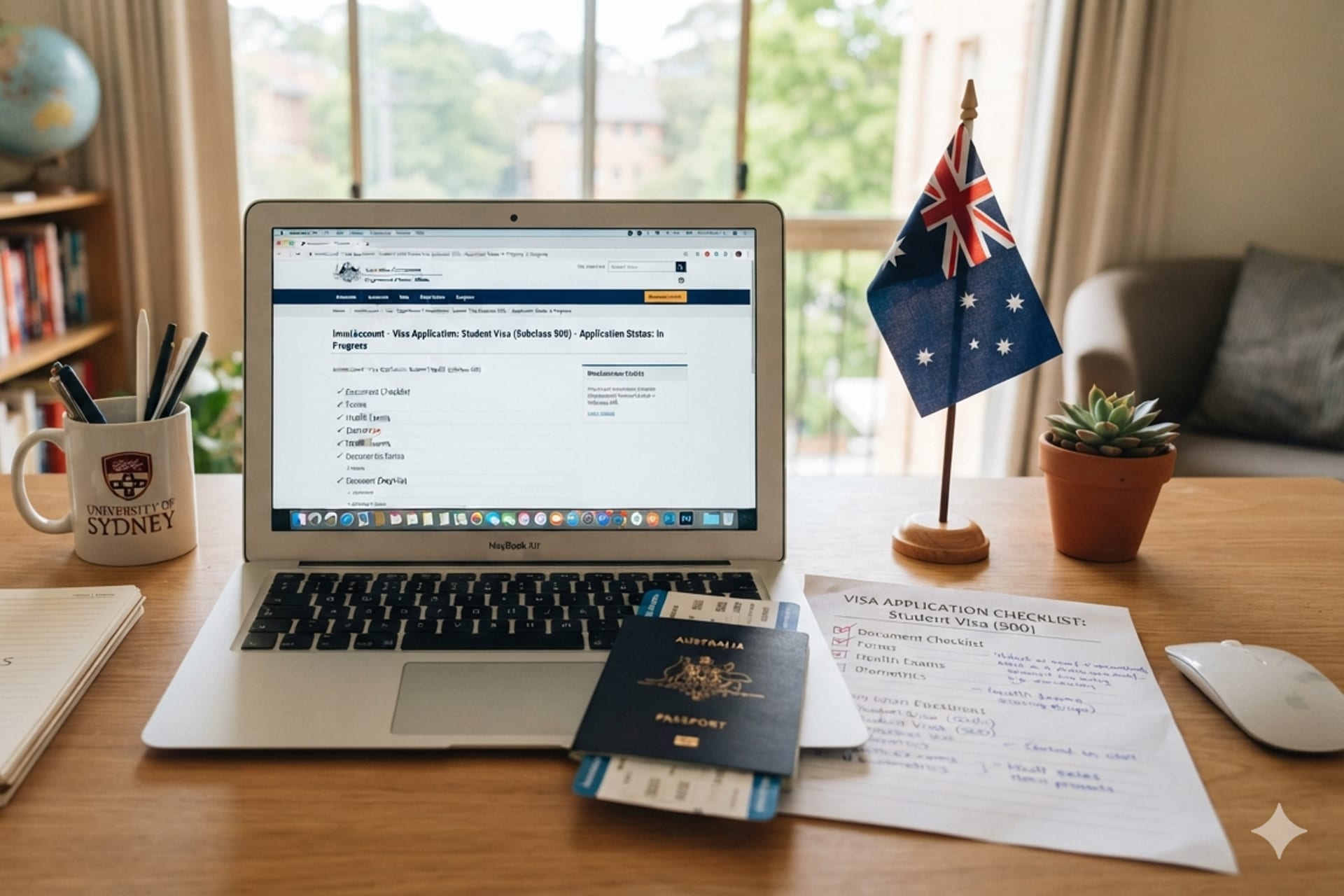

Quick Answer to Australia Student Visa Requirements & GS Rule 2026
Australia's Genuine Student requirement replaced the older Genuine Temporary Entrant test and assesses whether your course choice, academic background, finances and stated plans hold together. Alongside it you need a Confirmation of Enrolment, evidence of funds, Overseas Student Health Cover and usually IELTS 6.5 with no band below 6.0. A coherent, specific study rationale matters as much as meeting the numeric thresholds. Global Colliance has trained more than 15,000 students for IELTS and PTE, and sets each band target against the universities a student is actually applying to.
Meeting every requirement precisely is the key to a successful Australian student visa, especially with the newer Genuine Student rule in place. The Australia student visa requirements for 2026 cover your enrolment, finances, English proficiency, health cover and the crucial GS assessment. Understanding each one clearly, and preparing for it properly, is essential to avoid delays and refusals. This guide sets out the full requirements and explains the GS rule, based on our experience filing successful subclass 500 applications.
Overview of Australia Student Visa Requirements
The Australia student visa requirements for the subclass 500 fall into a few clear categories: enrolment in a registered course, meeting the Genuine Student rule, proving financial capacity, demonstrating English proficiency, arranging health cover and satisfying character and health checks.
Each requirement connects to the others, and your application is assessed as a whole. A strong profile in one area cannot fully offset a weakness in another, which is why preparing every requirement carefully and consistently is so important for a smooth outcome.
Understanding the full picture before you begin allows you to plan effectively. Rather than tackling requirements in isolation, the most successful applicants build a coherent file where enrolment, finances, English and intent all reinforce one another.
A useful way to approach the requirements is to see them as a single, connected story about a genuine student rather than a checklist of unrelated boxes. When your enrolment, finances, English and stated intentions all point in the same direction, the assessing officer sees consistency, which is exactly what builds confidence in your application.
The Genuine Student (GS) Rule Explained
The centrepiece of the current Australia student visa requirements is the Genuine Student rule, introduced in 2024 to replace the former Genuine Temporary Entrant test. The GS rule assesses whether you genuinely intend to study, through a set of targeted questions about your circumstances and plans.
You can review the official GS guidance on the official Department of Home Affairs subclass 500 page, which is the authoritative source. The assessment looks at your reasons for choosing the course and institution, how it fits your academic background, and how the qualification supports your future goals in a credible way.
Preparing genuine, well-structured GS responses is essential. Clear answers that connect your past studies, your chosen course and your future plans demonstrate authentic intent, which is exactly what the GS rule is designed to identify in strong applicants.
The shift from the old Genuine Temporary Entrant test to the Genuine Student rule reflects a sharper focus on study intent, so understanding what the questions are really asking matters. We help students respond to the substance behind each question, not just its wording, so their answers demonstrate authentic purpose rather than rehearsed phrases.
Financial Requirements for the Australia Student Visa
Financial capacity is one of the most important Australia student visa requirements. You must show funds to cover tuition, travel and living costs, with the living cost benchmark set at AUD 29,710 for a year as of the latest update, on top of your course fees.
Acceptable evidence includes bank statements, education loan sanction letters and sponsor documentation. The funds must be genuine, stable and clearly sourced, since sudden large deposits or unexplained money can undermine an otherwise strong application.
Presenting your finances clearly and consistently reassures the officer that you can support yourself. Well-organised proof that comfortably meets the benchmark is one of the strongest elements you can include in your subclass 500 application.
On finances, the benchmark figure is a minimum rather than a target, and demonstrating a comfortable margin above it strengthens your case. Well-documented, stable funds that clearly cover tuition, living costs and travel remove one of the most common reasons applications are questioned or delayed.
English Language Requirements
The Australia student visa requirements include demonstrating English proficiency through an accepted test such as IELTS, PTE or TOEFL. The score you need depends on your course and institution, so always confirm the specific requirement before booking your test.
Higher-level courses and certain institutions may require stronger scores, while some students may need additional English preparation before their main programme. Meeting the exact requirement, ideally with a comfortable margin, removes a common source of delay.
A recognised English score that clearly satisfies both your institution and the visa is essential. Preparing thoroughly for your test, and confirming the required level early, ensures this requirement never becomes a bottleneck in your application.
Health cover and character checks are sometimes treated as afterthoughts, but leaving them late is a frequent cause of avoidable delay. Arranging your Overseas Student Health Cover and completing any required medical or police checks early keeps these routine requirements from becoming last-minute obstacles.
Health Cover and Character Requirements
Overseas Student Health Cover, or OSHC, is a mandatory requirement for the full duration of your stay and must be arranged before your visa is granted. It ensures you have access to healthcare in Australia and is a standard, straightforward part of the process.
You must also meet character and health requirements, which may include a police clearance and a medical examination. These checks are routine, but completing them correctly and on time is essential to avoid delays in your application.
Arranging OSHC and completing your health and character checks alongside your other documents keeps your application coherent. Handling these practical requirements early ensures they are ready exactly when your subclass 500 application needs them.
Finally, remember that a complete, internally consistent file is worth more than any single strong document on its own. The applications that move quickly are those where every requirement has been prepared thoughtfully and checked against the others, which is precisely why we review each file as a whole before it is ever lodged.
Documents Needed for Australia Student Visa Requirements
To satisfy the Australia student visa requirements, you typically need your Confirmation of Enrolment, passport, GS responses, financial evidence, English test results, OSHC policy, academic transcripts and any required health and character documents.
Every document must be accurate and consistent with the others, since even small mismatches in names, dates or figures can raise questions. We always advise students to cross-check each document against their application before lodging.
A complete, well-organised document set is one of the strongest signals of a genuine, prepared applicant. Assembling everything carefully in advance keeps your application smooth and reduces the chance of follow-up requests.
How Global Colliance Helps You Meet Australia Student Visa Requirements
Meeting every requirement precisely, including the GS rule, is exactly where expert guidance pays off. Our Australia student visa consultants help you build a strong GS case, organise your finances, confirm your English requirement and assemble a complete, consistent document file.
You can also explore our full range of services on the Global Colliance homepage. With experienced support, the Australia student visa requirements become clear and manageable, and your journey to studying in Australia starts on the strongest possible footing.
Because we manage Australian applications regularly, we understand how the GS rule is assessed and how to present a genuine, well-documented case. That practical experience helps you avoid the common mistakes that lead to delays or refusals.
Planning Early to Meet Australia Student Visa Requirements
Because the Australia student visa requirements depend on several steps fitting together, early preparation is essential. Enrolment, finances, English and the GS responses all take time, and compressing them into a short window is where errors and inconsistencies appear.
Starting several months before your intended intake gives you room to gather documents carefully, build stable finances and prepare genuine GS answers without pressure. A calm, well-planned application is consistently stronger and far more likely to be approved.
By treating the requirements as one connected whole and preparing each thoroughly, you give your subclass 500 application the strongest possible chance of a timely approval, letting you focus on your exciting move to Australia.
To see how the Genuine Student answers fit the full application, read our guide to the Australia student visa from Gujarat.
For the current living cost amounts, the parent income route and how to prove genuine access to funds, see our guide to the Australia student visa financial requirements.
Your enrolment evidence has to be valid both at lodgement and at decision time, so read our explainer on CoE Australia before you apply.
FAQs About Australia Student Visa Requirements
What are the Australia student visa requirements for 2026?
You need enrolment in a registered course, to meet the Genuine Student rule, proof of finances covering AUD 29,710 in living costs plus tuition, English proficiency, health cover and character checks.
What is the GS rule for the Australia student visa?
The Genuine Student rule, introduced in 2024, assesses whether you genuinely intend to study, based on your circumstances, course choice and future plans, through a set of targeted questions.
How much money do I need for an Australia student visa?
You must show living costs of AUD 29,710 for a year as of the latest update, plus tuition and travel, through bank statements, loans or sponsor documents.
What English score is needed for an Australia student visa?
The required IELTS, PTE or TOEFL score depends on your course and institution, so confirm the specific level early and aim to exceed the minimum comfortably.
Is OSHC mandatory for the Australia student visa?
Yes. Overseas Student Health Cover is mandatory for the full duration of your stay and must be arranged before your subclass 500 visa is granted.