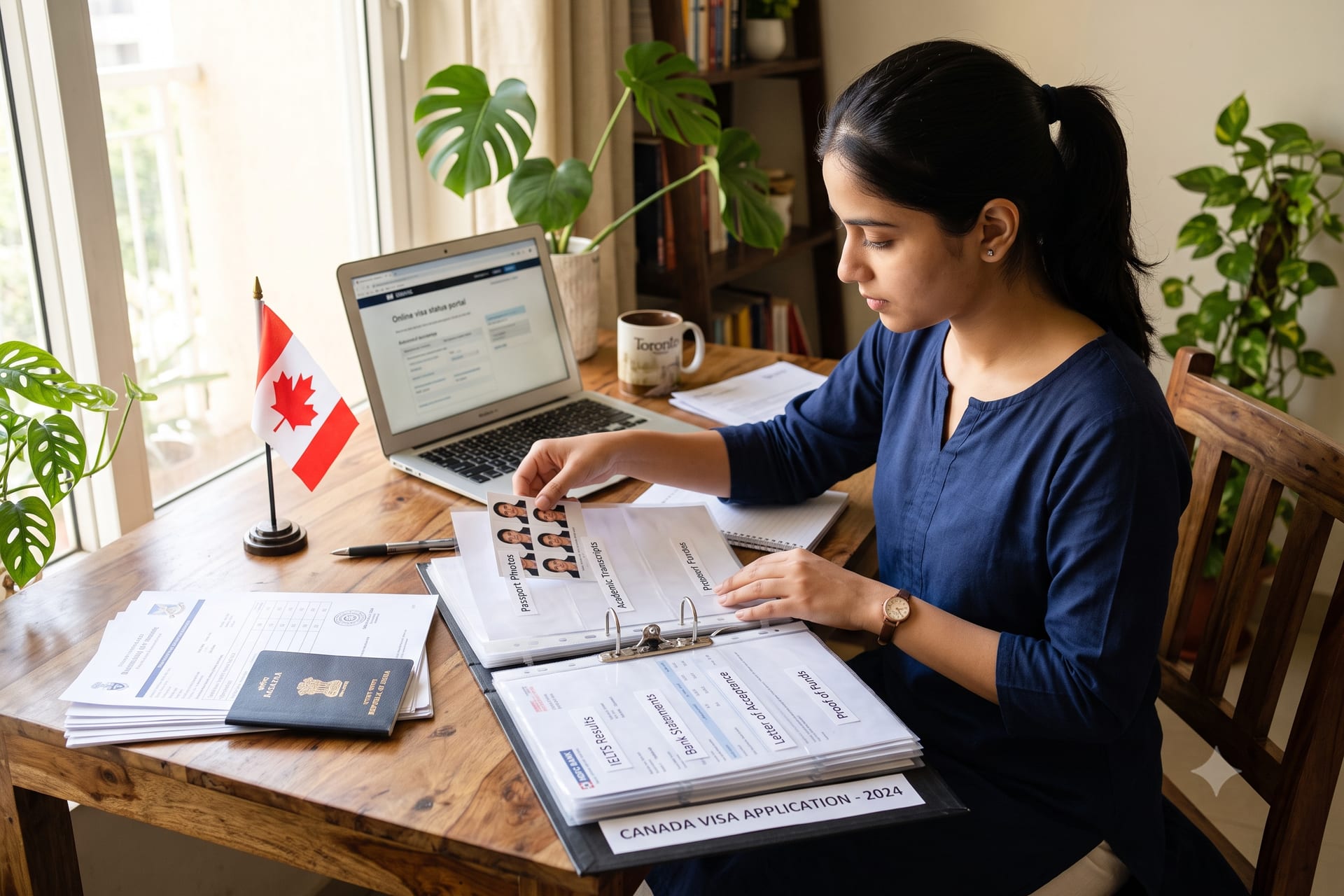

Quick Answer to Documents Required for a Canada Student Visa (2026 Checklist)
A Canada study permit application needs a valid passport, a letter of acceptance from a designated learning institution, proof of funds (commonly a GIC plus tuition payment receipt), academic transcripts and certificates, English test results, a statement of purpose, passport photographs, medical examination results and biometrics. Missing or inconsistent documents are a leading cause of refusal, so assemble the full set before filing. Global Colliance advises on funding, scholarships and the proof-of-funds documentation that most applications are judged on.
A Canadian study permit application succeeds or fails on the strength of its paperwork. Knowing exactly which documents for a Canada student visa you need, and preparing each one correctly, is the single most reliable way to avoid delays and refusals. Having reviewed thousands of student files, we have built this 2026 checklist so you can assemble a complete, officer-ready application from the start.
Use this guide as your master list. Tick off each section, keep both digital and physical copies, and make sure every detail matches across your documents.
Academic Documents for a Canada Student Visa
Your academic record establishes that you are a genuine student ready for your chosen program. Prepare your Class 10 and Class 12 mark sheets and certificates, your degree or diploma transcripts if applicable, and any consolidated mark sheets. If there is a study gap, keep supporting evidence such as work experience letters or additional certifications.
You will also need proof of English language proficiency, usually an IELTS or PTE score report that meets your college and visa requirements. Make sure names and dates are consistent across every academic document.
Admission Documents for a Canada Student Visa
The cornerstone here is your Letter of Acceptance from a Designated Learning Institution. This letter confirms your program, start date and duration, and it must be current. Alongside it, keep your tuition fee payment receipt, since paying the first year or first semester upfront strengthens your application and is mandatory for the Student Direct Stream.
Also keep a copy of your Provincial Attestation Letter if your province and program require one, as recent rules have introduced this requirement for many applicants.
Financial Documents for a Canada Student Visa
Proof of funds is where many applications weaken. You must show you can pay tuition and support yourself. Prepare your Guaranteed Investment Certificate of CAD 20,635 if applying through the Student Direct Stream, bank statements from the past several months, education loan sanction letters, fixed deposit certificates and any sponsor documents with proof of relationship and income.
Visa officers value stable, well-sourced funds over sudden large deposits. You can review the official document expectations on the Government of Canada study permit document page, which is the authoritative reference.
SOP and Personal Documents for a Canada Student Visa
Your Statement of Purpose ties everything together. It explains why you chose your program, this institution and Canada, how the course fits your goals, and why you will return home afterwards. A clear, honest and specific SOP reassures the officer that you are a genuine student.
On the personal side, you need a valid passport with adequate validity, recent passport-size photographs meeting Canadian specifications, and your family information forms filled accurately.
Medical and Biometric Documents for a Canada Student Visa
Most Indian applicants must complete an upfront medical examination with an IRCC-approved panel physician and include the confirmation in the application. You will also complete biometrics, providing fingerprints and a photo at a Visa Application Centre, and keep the biometrics receipt.
These steps are simple but time-sensitive, so schedule your medical early to avoid holding up an otherwise complete file.
How to Organise Documents for a Canada Student Visa
A complete file is not just about having the documents; it is about presenting them clearly. Arrange them in the order the application requests, label scans properly, keep file sizes within limits and ensure every date, name and amount is consistent. Small mismatches are a common and avoidable cause of refusal.
This is where working with specialists helps. Our Canada student visa consultants review every document, structure your financial file and prepare your SOP so your application is officer-ready. You can also explore our wider services on the Global Colliance homepage. A well-organised document set is your best insurance against delays.
Translations and Attestation in Documents for a Canada Student Visa
Any document that is not in English or French must be accompanied by a certified translation, and this requirement trips up more applicants than you might expect. Birth certificates, some academic records and financial documents issued in regional languages all need proper translation by a certified translator, along with the original. Submitting an untranslated or informally translated document is a common reason applications are returned or delayed.
Similarly, certain documents may need notarisation or attestation depending on your college and situation. Building in time for translations and attestation, rather than treating them as an afterthought, keeps your file complete. We recommend preparing these well before submission so a missing translation never holds up an otherwise strong application.
Digital Formatting of Documents for a Canada Student Visa
Because study permit applications are submitted online, how you scan and label your documents genuinely affects the outcome. Scans must be clear and legible, within the specified file-size limits, and saved in accepted formats. Blurry photographs of documents, oversized files that will not upload, and unlabelled scans that force the officer to guess what they are looking at all weaken your presentation.
A simple system solves this. Scan each document at a readable resolution, name every file clearly so its contents are obvious, and group them in the order the application requests. This small amount of care signals a serious, organised applicant and reduces the chance of a request for additional information that slows everything down.
Keeping Documents for a Canada Student Visa Consistent
Consistency across your documents is one of the quietest but most important factors in approval. Your name should be spelled identically on your passport, academic records, financial documents and application form. Dates of birth, addresses, program details and financial figures must all match. Even small discrepancies, such as a slightly different spelling of your name across two documents, can raise doubts and lead to avoidable questions or refusals.
Before you submit, do a careful cross-check of every document against your passport and your application. Confirm that the figures in your bank statements, GIC, loan sanction letter and Letter of Acceptance all align with what you have declared. This final consistency review is one of the highest-value checks you can do, and it is exactly the kind of detail experienced consultants examine closely before filing.
Final Review of Documents for a Canada Student Visa
Before you submit, a structured final review of your documents for a Canada student visa can catch the small errors that cause big delays. Start by laying out every required item against a checklist: academic records, English test score, Letter of Acceptance, tuition receipt, proof of funds, GIC where applicable, Statement of Purpose, passport, photographs, medical confirmation and biometrics. Confirm that nothing is missing and that each document is current and clearly legible.
Next, check for consistency across the entire file. Your name, date of birth, program details and financial figures should match exactly on every document and on your application form. Even a minor spelling difference between your passport and an academic certificate can raise questions, so reconcile any discrepancies before filing. Where documents are in a regional language, ensure certified translations are attached alongside the originals.
Finally, review the presentation. Scans should be clear, correctly named and within the specified file-size limits, and arranged in the order the application requests. A tidy, well-organised submission signals a serious applicant and reduces the chance of a request for additional information. Taking the time for this careful final review, which is exactly what experienced consultants do before filing, is one of the most reliable ways to keep your Canadian study permit application on track for a smooth, timely decision.
Expert Review of Documents for a Canada Student Visa
Even a well-organised applicant benefits from an expert review of their documents for a Canada student visa before submission. Consultants who handle many applications know exactly what officers look for, which documents are commonly overlooked, and how small inconsistencies can undermine an otherwise strong file. A professional second pair of eyes often catches issues that are easy to miss when you are close to your own application.
This review also ensures your documents tell a consistent, credible story. Your academics, finances, Statement of Purpose and program choice should all reinforce one another, presenting you clearly as a genuine student. By combining a complete checklist with careful cross-checking and expert judgment, you give your Canadian study permit application the strongest possible foundation and greatly reduce the risk of a request for more information or an avoidable refusal.
To see how these documents fit into the full application sequence, read our guide to the Canada study visa from Gujarat.
If you are comparing Canada with other destinations, our study abroad document checklist sets out the papers each country adds to the core file.
Once your file is submitted, the next task is your fingerprints and photo, and our guide to Canada study permit biometrics explains the 30 day deadline and what to bring.
FAQs About Documents for a Canada Student Visa
What documents are required for a Canada student visa in 2026?
You need academic records, an IELTS or PTE score, a Letter of Acceptance, tuition receipt, proof of funds including a GIC for the SDS route, a Statement of Purpose, a valid passport, photographs, medical exam confirmation and biometrics.
Is a GIC required in the documents for a Canada student visa?
A GIC of CAD 20,635 is required only for the Student Direct Stream route. For the regular Non-SDS route, you can prove funds through other financial documents.
Do I need a medical exam for a Canada student visa?
Most Indian applicants must complete an upfront medical examination with an IRCC-approved panel physician and include the confirmation in their application.
How important is the SOP among documents for a Canada student visa?
The SOP is very important. It explains your study choices, goals and ties to India, and a clear, genuine SOP significantly strengthens your application.
What is a Provincial Attestation Letter for a Canada student visa?
A Provincial Attestation Letter is a document from the province confirming your spot within its allocation. Many programs and provinces now require it, so check whether yours does before applying.